5V vs 12V vs 24V LED Lights: Why Roofline Lights Use Higher Voltage
By Jolly Raleigh · September 17, 2026
TL;DR: Voltage fades as it travels down a wire. On a 5-volt strip the far end of a roofline goes dim and reddish. Higher voltage (12 or 24 volts) carries the same power with less current, so it reaches farther before it fades. That is why permanent roofline systems run on 12 volts or more, and why long runs still get extra power feeds along the way.
If you have ever seen a string of lights that is bright at one end and orange and sad at the other, you have seen voltage drop. It is the single biggest wiring problem on a long roofline, and it is the reason permanent lighting does not run on the same 5 volts as a hobby strip.
What voltage drop is
Copper wire is a good conductor, but not a perfect one. Every foot of wire has a little resistance. Push current through it and some voltage is lost as heat along the way. The more current, and the longer the wire, the more you lose.
The lights at the far end get whatever voltage is left. If a 5-volt strip only sees 4 volts by the end, those lights are dim. And because the blue LED needs the most voltage of the three, blue drops out first. That is why a starved strip goes from white to yellow to orange to red as you move down it.
Why higher voltage fixes it
Power is voltage times current. To deliver the same power, you can use high voltage and low current, or low voltage and high current. Voltage drop depends on current. So less current means less drop.
QuinLED's power injection guide works a 20-meter (66-foot) example at the same 192 watts:
| Strip voltage | Current needed | Power feed points |
|---|---|---|
| 5V | 32 amps | 5 |
| 12V | 16 amps | 3 |
| 24V | 8 amps | 2 |
Same light, same length. The 5-volt strip needs four times the current of the 24-volt strip and more than twice as many places to feed in power.
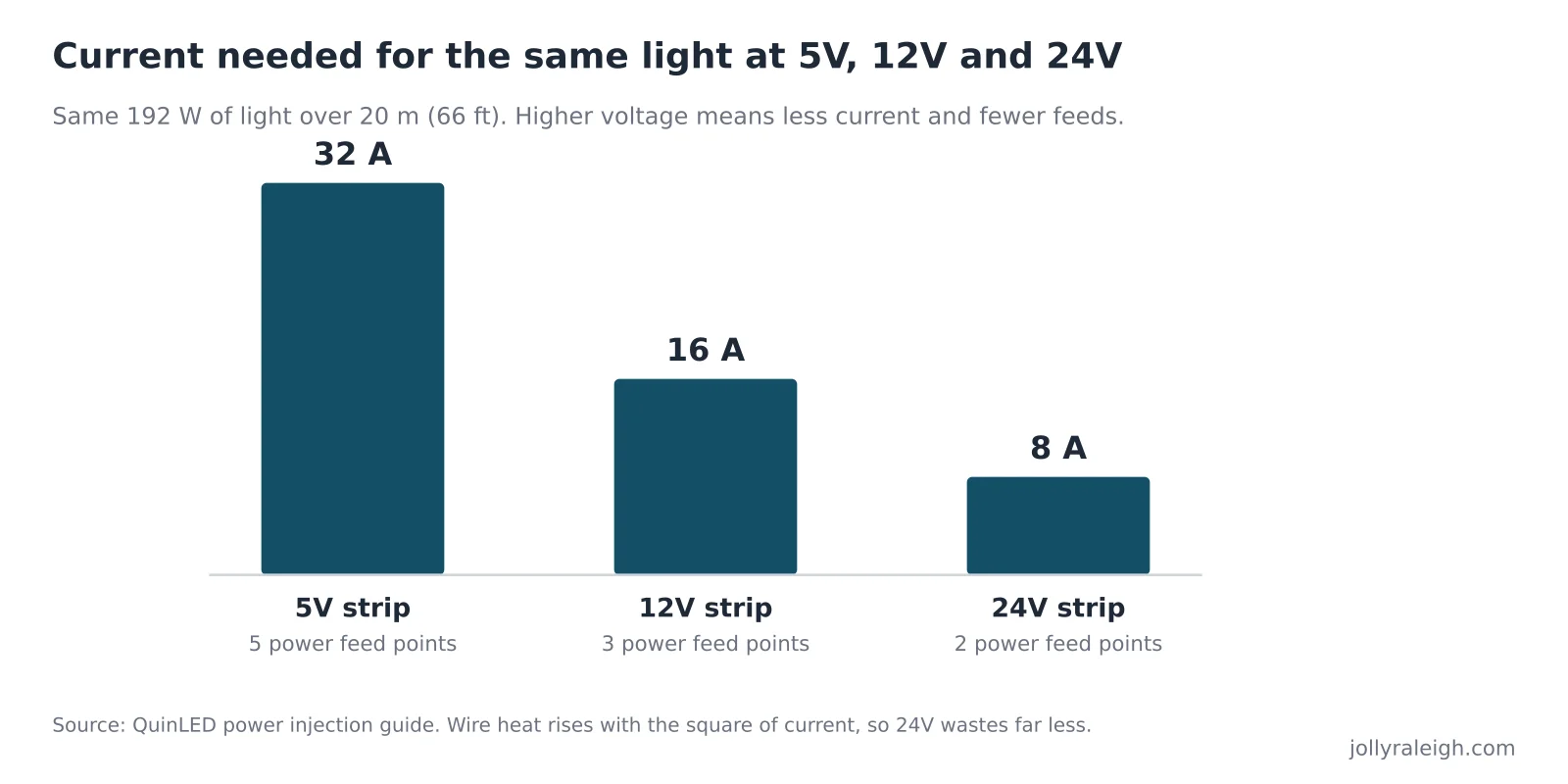
There is a second win. Heat lost in a wire goes up with the square of the current. Cut the current in half and the wasted heat drops to one quarter. That means thinner, cheaper wire and cooler connections.
How far can you run each voltage from one feed?
Rules of thumb from HitLights' run-length guide and We Love LEDs' voltage guide:
- 5V: feed power about every 5 meters (16 feet).
- 12V: about 5 meters from a single feed before dimming shows.
- 24V: about 7 to 10 meters (23 to 33 feet) from a single feed.
Those are for full-brightness white, which is the worst case. Run mostly colors or dim scenes and you can stretch farther. A roofline is long. A typical Raleigh ranch has 100 to 150 feet of eave. Even at 24 volts, that needs power fed in at several points.
Power injection: feeding the middle of the run
"Power injection" just means running an extra power wire from the supply to a point partway down the lights. The data wire keeps going light to light. The power wire takes a shortcut.
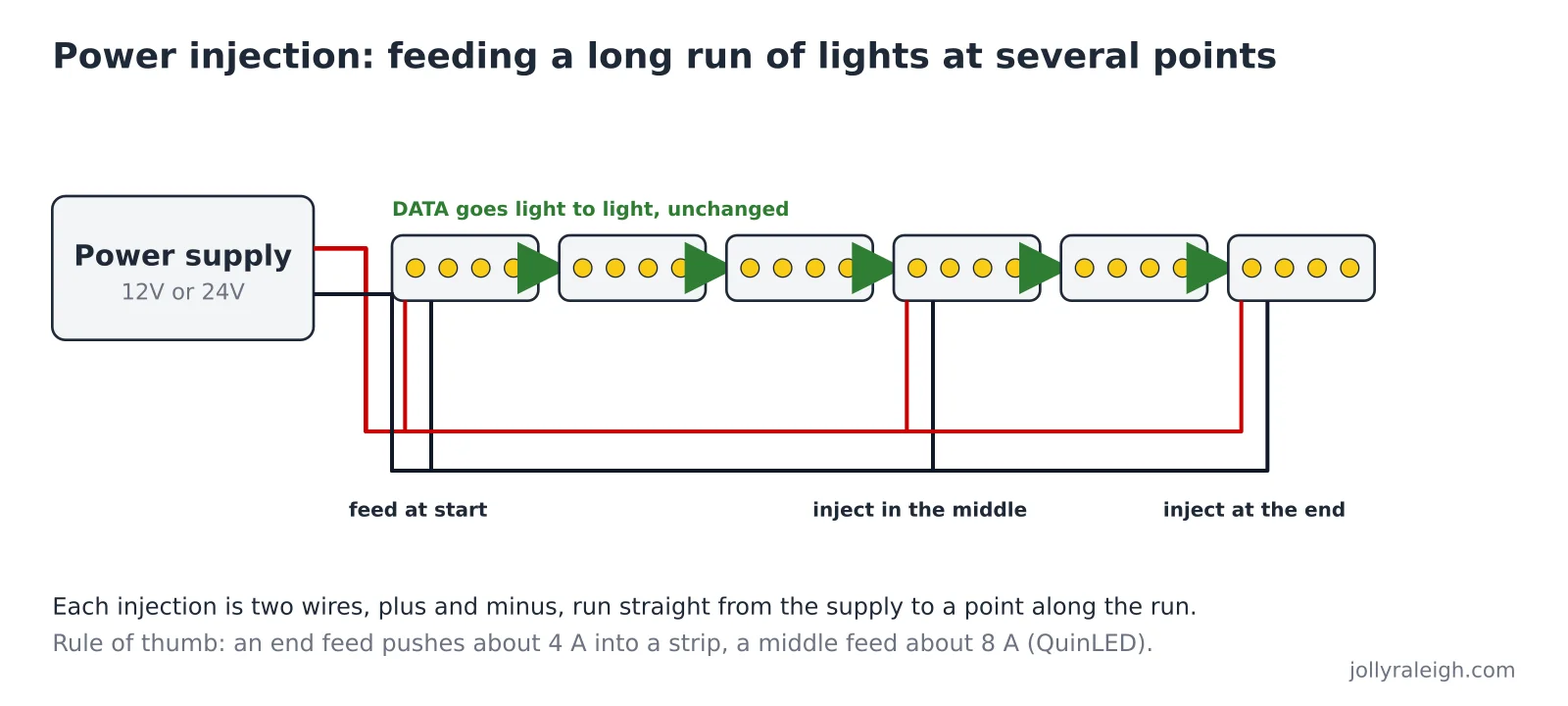
QuinLED's guide gives two useful limits: a feed at the end of a strip can push about 4 amps into it, and a feed in the middle about 8 amps, because the current can split both directions. And any injection wire should lose no more than 10 percent of the voltage over its length. Thicker wire loses less.
Every ground must connect back to the supply too. Power injection is always two wires, plus and minus, never just the plus.
What the big permanent lighting brands run
This is not a hobby-only idea. Trimlight's own comparison pages describe their system as 12-volt, and describe Jellyfish Lighting as a 48-volt system (Trimlight vs Jellyfish). Nobody in the permanent lighting business runs 5 volts on a roof. The physics does not allow it.
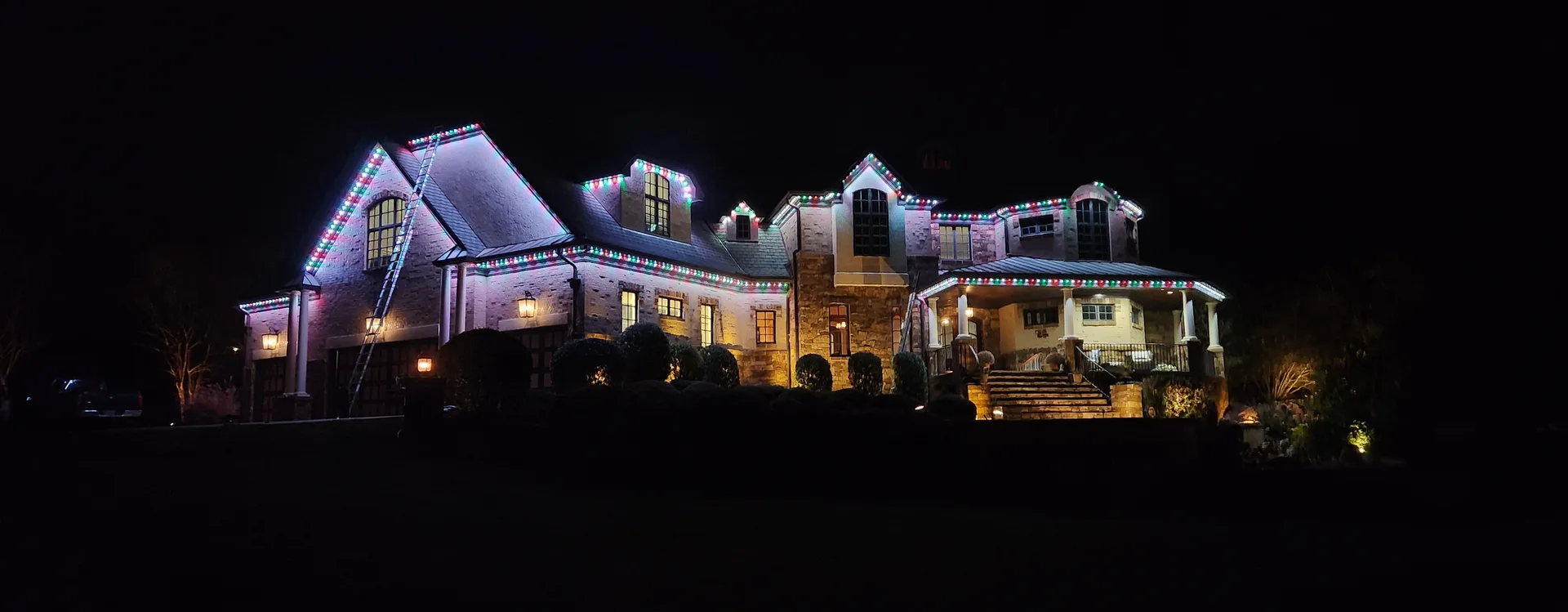
Our permanent RGB lighting is planned the same way: the voltage, the wire gauge, and the feed points are sized to the length of your roofline, so the last light on the far corner is as bright as the first one by the front door.
Trade-offs: 12V vs 24V
Higher is not free.
- Pixel grouping. Many 12-volt addressable strips wire three LEDs to one chip, so the smallest controllable "pixel" is a group of three. On a roofline with a light every 9 inches that does not matter much. On a dense strip it changes the look. SuperLightingLED's WS2811 vs WS2812B comparison covers this.
- Data signal. Twelve-volt chips are often stricter about the data signal than 5-volt chips. The controller usually needs a level shifter. See what controls permanent lights: the microcontroller explained.
- Never mix voltages on one supply. A 12-volt supply destroys a 5-volt strip on contact. A 5-volt supply leaves a 12-volt strip dim or dead. If you must chain different voltages, each strip gets its own supply and every ground is tied together. See how permanent Christmas lights are wired.
Signs your roofline has a voltage problem
- White looks warm or orange at the far end but clean near the controller.
- The last few feet flicker when you pick bright white but not when you pick red.
- Lights dim when you turn brightness up, or the whole run resets.
- The controller reboots when you switch to full white.
All of these mean the far end is not getting enough voltage. The fix is more feed points or thicker wire, not a new controller.
Frequently asked questions
Are 12V or 24V LED lights better?
For long outdoor runs, 24V reaches farther between power feeds and wastes less heat in the wire. For short runs with fine detail, 5V or 12V with per-LED control can look better. Roofline systems are almost always 12V or higher.
Can I run 12V lights on a 5V power supply?
No. They will be dim or not light at all. Use the voltage printed on the strip.
What does power injection mean?
Adding an extra pair of power wires from the supply to a point partway along the lights, so the far end gets full voltage. The data wire is unchanged.
Why does the end of my LED strip turn red?
Voltage drop. Blue needs the most voltage, so it drops out first, then green, leaving red. Feed power closer to that end.